 English
 Spanish
 French
 German
 Italian
 Chinese (Simplified)
 Japanese
 Korean
 Arabic
 Portuguese
 08045804620

 Send Inquiry
Nichrome A Reverse Dutch Weave Wire Mesh
Price 50 INR/ Unit
MOQ : 1 Unit
Nichrome A Reverse Dutch Weave Wire Mesh Specification
- Length
- 10 m - 30 m (standard rolls)
- Wire Gauge
- 0.4 mm - 1.2 mm
- Surface Treatment
- Coated
- Aperture
- Varies (typically 0.025 mm - 2 mm)
- Hole Shape
- Reverse Dutch Weave (rectangular/slot openings)
- Product Type
- Wire Mesh
- Mesh Type
- Reverse Dutch Weave
- Mesh Style
- Plain Mesh
- Material
- Nichrome
- Alloy
- NiCr 80/20
- Application
- Other
- Dimensions
- Customized as per requirement (commonly 2 ft x 30 m rolls)
- Wire Diameter
- 0.4 mm - 1.2 mm
- Weight
- Depends on size and gauge (typically 3.5 kg - 18 kg per roll)
- Color
- Silver
- Edge Type
- Cut or bound edges
- Corrosion Resistance
- Excellent
- Tensile Strength
- High
- Weave Type
- Reverse Dutch Weave
- Usage
- Filtration, heating elements, insulation, industrial separation
- Packing
- Rolls, wrapped with waterproof paper
- Operating Temperature
- Up to 1200°C
Nichrome A Reverse Dutch Weave Wire Mesh Trade Information
- Minimum Order Quantity
- 1 Unit
- Supply Ability
- 5000 Units Per Month
- Delivery Time
- 7 Days
About Nichrome A Reverse Dutch Weave Wire Mesh
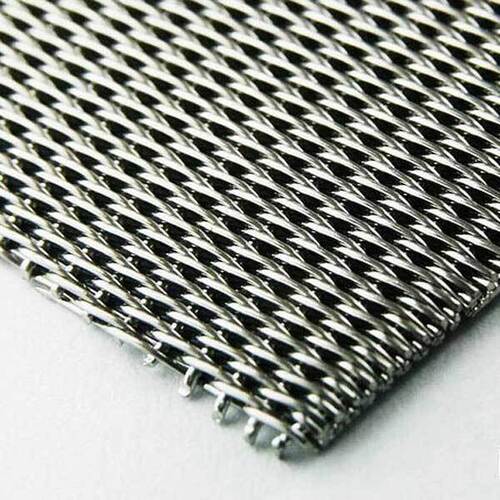
Nichrome is the alloy of nickel and chrome and, according to different chemical compositions, can be divided into Cr20Ni80, Cr15Ni60 and Cr20Ni35. Nichrome is made of the nichrome wire and has outstanding ductility, oxidation resistance, high tensile strength, sulphur resistance and other features.The same weave as Plain Dutch except the warp and Shute wires are reversed; i.e., the warp wires have a smaller diameter than the Shute wires. The type of cloth is mechanically highly sturdy with a high throughput and it does particularly well in high pressure vertical and horizontal filter leaf applications where backwashing and filter cake removal are vital.
We offer an exclusive range ofNichrome Reverse Dutch Weave Wire Meshat unmatched quality and market leading prices.
Exceptional Durability and High Temperature Resistance
This Reverse Dutch Weave wire mesh is engineered to withstand operating temperatures up to 1200C, making it suitable for demanding applications where both heat and corrosion resistance are essential. The NiCr 80/20 alloy provides an extended lifespan and maintains structural integrity under harsh industrial conditions.
Versatile Industrial Applications
Nichrome A wire mesh finds use in filtration, heating elements, insulation, and industrial separation. Its design with rectangular slot-shaped apertures ensures precise particle retention and efficient throughput. Packaged standardly in waterproof paper, the rolls can suit various processes requiring durability and consistency.
FAQs of Nichrome A Reverse Dutch Weave Wire Mesh:
Q: How is Nichrome A Reverse Dutch Weave Wire Mesh typically used in industrial settings?
A: It is primarily used for filtration, heating elements, insulation, and industrial separation due to its high temperature tolerance, excellent corrosion resistance, and precise rectangular openings that allow for controlled fluid or gas flow.Q: What benefits does the Reverse Dutch Weave provide compared to conventional mesh?
A: The Reverse Dutch Weave produces slot-shaped apertures that enable fine filtration and enhance mechanical strength, making it suitable for demanding separation processes and prolonged operational use without deformation.Q: When should I opt for a Nichrome mesh with coated surfaces and bound edges?
A: You should choose a coated surface and bound edges when additional corrosion protection or improved handling is required, especially in environments exposed to chemicals or where edge safety is a priority during installation.Q: Where can customized dimensions be ordered for this wire mesh?
A: Custom sizes of Nichrome A Reverse Dutch Weave Wire Mesh can be ordered directly from exporters, manufacturers, suppliers, or traders based in India, catering to precise specifications for length, width, and wire diameter.Q: What is the standard packing process for Nichrome A wire mesh rolls?
A: The wire mesh is packed in rolls and securely wrapped with waterproof paper to prevent moisture ingress and damage during transit and storage, ensuring the integrity of the product upon delivery.Q: How does the alloy composition (NiCr 80/20) benefit the wire mesh?
A: The NiCr 80/20 alloy imparts excellent corrosion resistance and high tensile strength to the mesh, making it suitable for high-temperature and aggressive environments, thereby extending its operational lifespan and reliability.Q: What hole shapes and aperture sizes are available in the Reverse Dutch Weave?
A: The Reverse Dutch Weave features slot-shaped or rectangular openings with apertures typically varying from 0.025 mm to 2 mm, which can be customized to match specific filtration or separation requirements.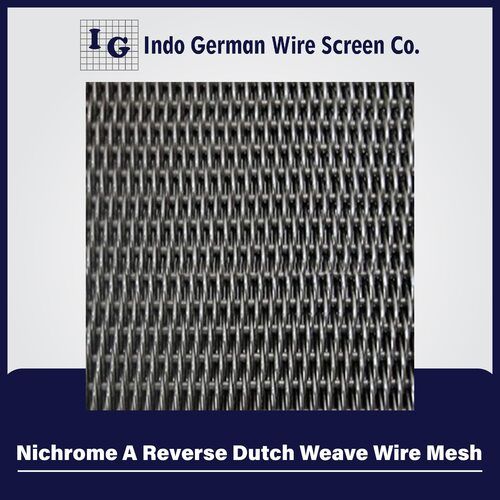
Tell us about your requirement

Price:
Quantity
Select Unit
- 50
- 100
- 200
- 250
- 500
- 1000+
Additional detail
Mobile number
Email

More Products in Reverse Dutch Weave Wire Mesh Category
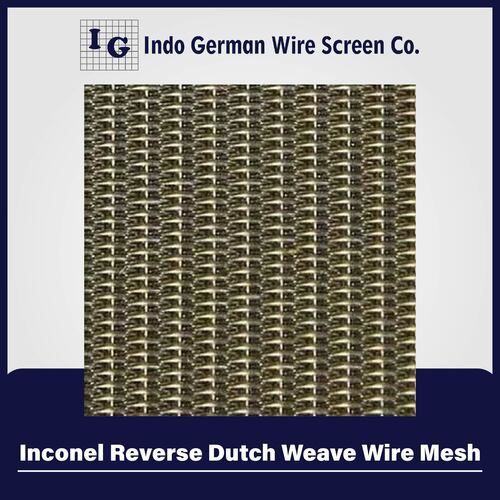
Inconel Reverse Dutch Weave Wire Mesh
Price 50.0 INR / Unit
Minimum Order Quantity : 1 Unit
Mesh Style : Plain Mesh
Product Type : Wire Mesh
Surface Treatment : Coated
Material : Other
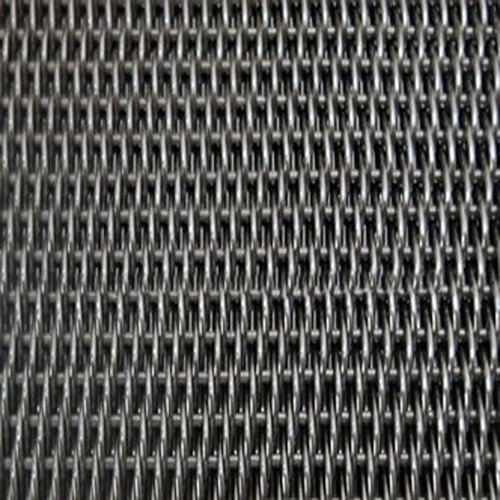
Mild Steel Reverse Dutch Weave Wire Mesh
Price 50 INR / Unit
Minimum Order Quantity : 1 Unit
Mesh Style : Plain Mesh
Product Type : Wire Cloth
Surface Treatment : Coated
Material : Other, Mild Steel

Stainless Steel Welded Reverse Dutch Weave Wire Mesh
Price 50.0 INR / Unit
Minimum Order Quantity : 1 Unit
Mesh Style : Plain Mesh
Product Type : Wire Mesh
Surface Treatment : Coated
Material : Stainless Steel
Aluminium Reverse Dutch Weave Wire Mesh
Price 50 INR / Unit
Minimum Order Quantity : 1 Unit
Mesh Style : Plain Mesh
Product Type : Wire Mesh
Surface Treatment : Coated
Material : Aluminum

Contact Details
INDO GERMAN WIRE SCREEN CO.
GST : 27AGKPD4601J1ZK
GST : 27AGKPD4601J1ZK
address
- 134, Keytuo Industrial Estate, 220, Kondivita Road, Andheri (East), Mumbai - 400059, Maharashtra, India
- Phone :08045804620
- Send Inquiry
 Send Inquiry
Key Personnal
- Mr Manoj Doshi (Marketing Manager)
- Mobile :08045804620

|


 Send Inquiry
 Send SMS
 |
INDO GERMAN WIRE SCREEN CO.
All Rights Reserved.(Terms of Use) Developed and Managed by Infocom Network Private Limited. |
